30
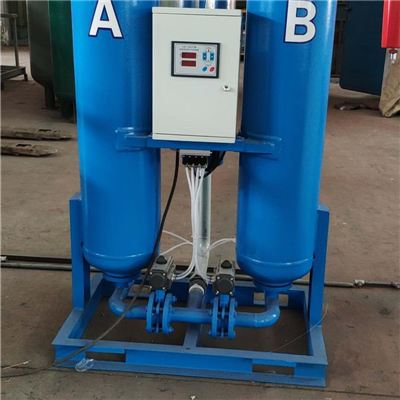
Micro heat adsorption dryer
2024/1/31

There were three industrial methods used for drying compressed air
1)Using adsorbents to selectively adsorb water vapor in compressed air for dehydration and drying.Like adsorption compressed air dryer.
2)Utilize the deliquescence properties of certain chemical substances for dehydration and drying.Like a moisture resistant compressed air dryer.
3)Using the characteristic that the partial pressure of water vapor in compressed air is determined by the temperature of the compressed air for cooling,dehydration,and drying.Like a frozen compressed air dryer.Among the three types of compressed air drying equipment mentioned above,the deliquescent compressed air dryer has been basically phased out;Cold drying machines and adsorption compressed air dryers(hereinafter referred to as"suction dryers")are widely used.Compared with vacuum dryers,refrigerated dryers have the following characteristics:1)no compressed air consumption-most users do not have high requirements for the dew point of compressed air,such as using a refrigerated dryer to save energy compared to using a vacuum dryer;2)No valve wear-The vacuum dryer has a switching valve problem,although there are also valve parts in the cold dryer,there is basically no wear problem;3)No need to regularly add or replace adsorbents;4)Low operating noise;The suction dryer has noise from the pressure relief of the adsorption tower,and in the compressed air room,the operating noise of the refrigerated dryer is generally not heard;5)Daily maintenance is relatively simple,as long as the automatic drain filter is cleaned on time;6)The pre-treatment requirements for the gas source are not high,and a general oil-water separator can meet the intake quality requirements of a refrigerated dryer;Compared with adsorption dryers,the pressure dew point of compressed air treated by cold dryers can only reach above 0℃,so the drying depth of the gas is far lower than that of suction dryers.In some application fields,using a cold dryer cannot meet the process's requirements for air source dryness,such as pneumatic instruments,electronic factories,etc.J-CD type refrigerated dryers(our company's products)are divided into two types based on the cooling method of the condenser:air-cooled and water-cooled;According to the intake temperature,there are high-temperature intake types(below 80℃)and ambient temperature intake types(below 45℃);According to working pressure,there are three types:low-pressure type(0.3-0.6MPa),ordinary type(0.6-0.95MPa),and medium and high-pressure type(≥1.0MPa)
1.Classification of adsorption dryers:
Adsorption dryers are divided into simple adsorption dryers(disposable)and regenerative adsorption dryers(automatic circulation type).We often use regenerative adsorption dryers in our daily lives,and simple adsorption dryers are often used in small laboratories.
Regenerative adsorption dryers are generally divided into non heat regenerative adsorption dryers and heat regenerative adsorption dryers.
Heat regeneration adsorption dryers can be divided into internal heating adsorption dryers and external heating adsorption dryers according to the heating method.
2.Operating principle of regenerative adsorption dryer:
The regenerative adsorption dryer consists of two double line cylinders,which are filled with desiccant(the surface of the desiccant can absorb water).The two cylinders take turns turning on and off the airflow,alternating between drying and regeneration operations,so that the airflow can continuously come into contact with the dry desiccant to achieve the purpose of dehumidification and drying.
3.Drying principle of non heat regeneration adsorption dryer:
The non heat regeneration adsorption dryer achieves drying effects through pressure changes.Due to the inverse ratio between the ability of air to hold water vapor and pressure.After drying,a portion of the dry air(called regenerated gas)is depressurized and expanded to atmospheric pressure.This pressure change makes the expanded air more dry,and then it flows through the desiccant layer that needs to be regenerated without connecting the airflow(i.e.a drying tower that has absorbed enough water vapor).The dried regenerated gas sucks out the moisture in the desiccant and carries it out of the desiccant to achieve the purpose of dehumidification and drying.The non heat regeneration adsorption dryer generally consumes about 15%of the regenerated compressed air.
4.Drying principle of a hot regeneration adsorption dryer:
The hot regeneration adsorption dryer achieves drying effects through temperature changes.Because the ability of air to hold water vapor is directly proportional to temperature.The internally heated adsorption dryer allows a small amount of dry air(called regeneration gas)to flow through the desiccant layer that needs to be regenerated and activate the heater built-in in the machine barrel.The generated high-temperature air will suck out the moisture in the desiccant and take it out of the dryer.
One type of externally heated adsorption dryer is to allow a small amount of dry air(called regeneration gas)to flow through an external heater and then blow through the desiccant layer that needs to be regenerated.The high-temperature dry air produced will suck out the moisture in the desiccant and take it out of the dryer.Another type of external heating adsorption dryer is to use a blower to blow ordinary air through the heater placed outside the machine barrel,producing high-temperature air that can suck out the moisture in the desiccant and take it out of the dryer.This externally heated adsorption dryer does not require the consumption of compressed air.That is,the consumption of regeneration gas is 0%.
1)Using adsorbents to selectively adsorb water vapor in compressed air for dehydration and drying.Like adsorption compressed air dryer.
2)Utilize the deliquescence properties of certain chemical substances for dehydration and drying.Like a moisture resistant compressed air dryer.
3)Using the characteristic that the partial pressure of water vapor in compressed air is determined by the temperature of the compressed air for cooling,dehydration,and drying.Like a frozen compressed air dryer.Among the three types of compressed air drying equipment mentioned above,the deliquescent compressed air dryer has been basically phased out;Cold drying machines and adsorption compressed air dryers(hereinafter referred to as"suction dryers")are widely used.Compared with vacuum dryers,refrigerated dryers have the following characteristics:1)no compressed air consumption-most users do not have high requirements for the dew point of compressed air,such as using a refrigerated dryer to save energy compared to using a vacuum dryer;2)No valve wear-The vacuum dryer has a switching valve problem,although there are also valve parts in the cold dryer,there is basically no wear problem;3)No need to regularly add or replace adsorbents;4)Low operating noise;The suction dryer has noise from the pressure relief of the adsorption tower,and in the compressed air room,the operating noise of the refrigerated dryer is generally not heard;5)Daily maintenance is relatively simple,as long as the automatic drain filter is cleaned on time;6)The pre-treatment requirements for the gas source are not high,and a general oil-water separator can meet the intake quality requirements of a refrigerated dryer;Compared with adsorption dryers,the pressure dew point of compressed air treated by cold dryers can only reach above 0℃,so the drying depth of the gas is far lower than that of suction dryers.In some application fields,using a cold dryer cannot meet the process's requirements for air source dryness,such as pneumatic instruments,electronic factories,etc.J-CD type refrigerated dryers(our company's products)are divided into two types based on the cooling method of the condenser:air-cooled and water-cooled;According to the intake temperature,there are high-temperature intake types(below 80℃)and ambient temperature intake types(below 45℃);According to working pressure,there are three types:low-pressure type(0.3-0.6MPa),ordinary type(0.6-0.95MPa),and medium and high-pressure type(≥1.0MPa)
1.Classification of adsorption dryers:
Adsorption dryers are divided into simple adsorption dryers(disposable)and regenerative adsorption dryers(automatic circulation type).We often use regenerative adsorption dryers in our daily lives,and simple adsorption dryers are often used in small laboratories.
Regenerative adsorption dryers are generally divided into non heat regenerative adsorption dryers and heat regenerative adsorption dryers.
Heat regeneration adsorption dryers can be divided into internal heating adsorption dryers and external heating adsorption dryers according to the heating method.
2.Operating principle of regenerative adsorption dryer:
The regenerative adsorption dryer consists of two double line cylinders,which are filled with desiccant(the surface of the desiccant can absorb water).The two cylinders take turns turning on and off the airflow,alternating between drying and regeneration operations,so that the airflow can continuously come into contact with the dry desiccant to achieve the purpose of dehumidification and drying.
3.Drying principle of non heat regeneration adsorption dryer:
The non heat regeneration adsorption dryer achieves drying effects through pressure changes.Due to the inverse ratio between the ability of air to hold water vapor and pressure.After drying,a portion of the dry air(called regenerated gas)is depressurized and expanded to atmospheric pressure.This pressure change makes the expanded air more dry,and then it flows through the desiccant layer that needs to be regenerated without connecting the airflow(i.e.a drying tower that has absorbed enough water vapor).The dried regenerated gas sucks out the moisture in the desiccant and carries it out of the desiccant to achieve the purpose of dehumidification and drying.The non heat regeneration adsorption dryer generally consumes about 15%of the regenerated compressed air.
4.Drying principle of a hot regeneration adsorption dryer:
The hot regeneration adsorption dryer achieves drying effects through temperature changes.Because the ability of air to hold water vapor is directly proportional to temperature.The internally heated adsorption dryer allows a small amount of dry air(called regeneration gas)to flow through the desiccant layer that needs to be regenerated and activate the heater built-in in the machine barrel.The generated high-temperature air will suck out the moisture in the desiccant and take it out of the dryer.
One type of externally heated adsorption dryer is to allow a small amount of dry air(called regeneration gas)to flow through an external heater and then blow through the desiccant layer that needs to be regenerated.The high-temperature dry air produced will suck out the moisture in the desiccant and take it out of the dryer.Another type of external heating adsorption dryer is to use a blower to blow ordinary air through the heater placed outside the machine barrel,producing high-temperature air that can suck out the moisture in the desiccant and take it out of the dryer.This externally heated adsorption dryer does not require the consumption of compressed air.That is,the consumption of regeneration gas is 0%.
- Related information

Anhui Hangjia Machinery Equipment Co., Ltd Copyright 皖ICP备2024034088号-1 Disclaimer